01 Motivation
Is ambient sound a cognitive catalyst?
In behavioural intervention and everyday study, we often try to improve focus by modifying the environment — for example, by playing background music. But does music tempo actually enhance reading comprehension performance?
This experiment was born from a simple observation within our group: all of us study with different kinds of music. We designed a controlled quantitative study using G*Power for sample size estimation and R Studio (one-way ANOVA) for analysis — and ultimately confronted a null result that taught us more than a significant one ever could.
02 Research Foundation
What did the literature say?
Shen (2014) Participants who listened to classical music scored highest on reading comprehension tests, suggesting certain musical features may facilitate cognitive processing.
Dalton &
Behm (2007) Listening to fast-tempo music was associated with faster response speed, pointing toward an arousal-modulation mechanism linked to BPM.
03 Methodology
Experiment design
Design
1 × 3 ANOVA
Between-subjects
DV
Reaction Time
+ Accuracy (%)
Participants
79 students
NCKU, aged 18–25
Power Analysis
G*Power
est. n = 66
Analysis Tool
R Studio
one-way ANOVA
🎧Condition A · High Arousal
120–168
BPMFast-tempo instrumental music. Expected to create a high-arousal state and accelerate information processing speed.
☕Condition B · Low Arousal
66–76
BPMSlow-tempo instrumental music. Expected to reduce anxiety and improve reading comprehension accuracy.
🤫Condition C · Baseline
0
BPM / SilenceNo background sound. Establishes a pure baseline, eliminating all auditory stimulation.
💡 Why instrumental-only music? To avoid dual-task interference — lyrics and a Chinese reading comprehension test would compete for the same language processing resources in the brain, confounding the effect of tempo itself.
04 Results
Statistical Output · One-way ANOVA
Music tempo had no significant effect
on reading performance.
Reaction Time · One-way ANOVA
F(2,75) = 0.543
p = 0.583
⚠ Unexpected Direction
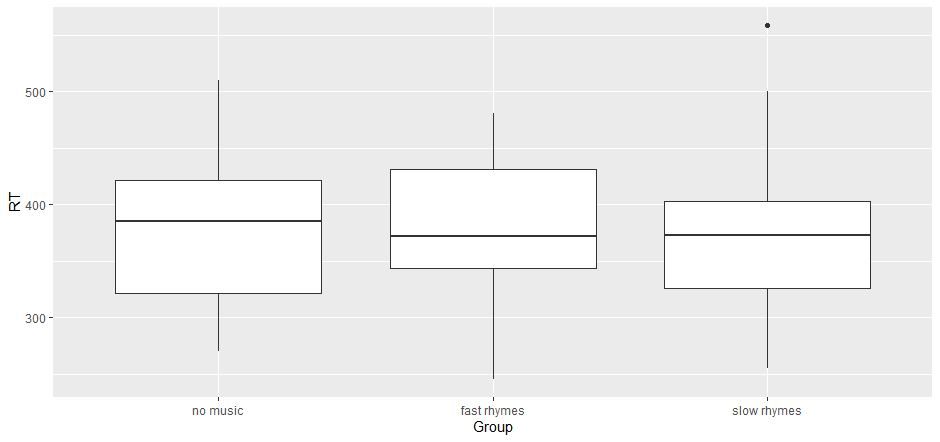
Slow tempo fastest > Silence > Fast tempo slowest
p = 0.583 far exceeded α = 0.05 — the null hypothesis could not be rejected. More striking: the actual ranking reversed our hypothesis. The slow-tempo group responded fastest, and the fast-tempo group was slowest — the opposite of what arousal theory predicted. A null result isn't a failed experiment. It's a signal pointing directly at what we didn't control for.
Fig 1. one-way repeated measures ANOVA boxplot — Reaction Time (seconds) across three conditions.
Slow tempo group showed shortest median RT; no significant between-group difference (p = 0.583).
05 Root-Cause Analysis
Four confounds that diluted the signal
CONFOUND · 01
Individual Baseline Capability
High Impact Bug Each participant's pre-existing verbal ability varied widely, diluting the small effect music tempo may have produced. We had no pre-test to account for this.
Next Step Add a pre-test (baseline measurement) and apply ANCOVA to statistically control for individual ability — directly mirroring best practice in behavioural intervention design.
CONFOUND · 02
Environmental Noise Contamination
Medium Impact Bug Testing in a shared computer lab meant mouse-click sounds and volume variation from other participants became uncontrolled auditory distractors — especially damaging for the silence condition. Post-test questionnaires confirmed multiple participants flagged this.
Next Step Use isolated booths, require noise-cancelling headphones across all conditions, and record ambient noise levels in dB as a covariate.
CONFOUND · 03
Protocol Adherence & UX Failure
Design Issue Bug Two participants began answering before instructions were complete, corrupting reaction time data at the source.
Next Step Lock the response button until instructions finish — a simple UX constraint that enforces protocol adherence systemically, removing reliance on participant compliance.
CONFOUND · 04
Demand Characteristics & Music Familiarity
Often Overlooked Bug The recruitment form directly stated the study topic ("Effects of Music on Learning"), potentially priming participants' expectations before they arrived. Additionally, the specific songs used — piano covers of popular Taiwanese pop songs — were recognisable to many participants, introducing familiarity as an uncontrolled variable.
Next Step Use a masked recruitment title to prevent demand characteristics. Conduct a familiarity pre-screen and select stimuli participants have not heard before, or explicitly measure and control for familiarity as a covariate.
06 Future Directions
Where this study could go next
Extend A Vocal vs. Instrumental: Replacing instrumental music with vocal tracks (Chinese vs. English lyrics) would test whether linguistic familiarity — not tempo — is the active ingredient. Prior work (Ren, 2019) found English-lyric music actually facilitated Chinese reading, suggesting language-processing competition is the stronger variable.
Extend B Familiarity as IV: Match each participant's study environment to their self-reported habitual background — measuring whether deviation from one's norm, rather than tempo per se, drives performance changes.
Extend C Multisensory Interaction: Research suggests coffee aroma activates the autonomic nervous system and enhances focus. A 2×3 factorial design crossing aroma (present/absent) × tempo (fast/slow/silence) could reveal interaction effects invisible to single-factor studies.
07 Clinical Relevance
Why this matters beyond the lab
Even a null result carries practical value. If no specific tempo reliably boosts performance, it suggests that personal familiarity and habit — not a universal "optimal" music condition — are the real drivers of cognitive efficiency. This reframes the question for applied settings:
In clinical and therapeutic environments (waiting rooms, hospital wards, counselling spaces), background music selection should be individualised. Research shows instrumental music can reduce depression symptoms and anxiety, and improve cognitive performance in patients (Aalbers, 2017; Mina, 2021). Rather than prescribing a single soundtrack, practitioners should assess each patient's habitual sound environment and match interventions accordingly — the same principle that underpins person-centred psychological care.
// Key Takeaway
"A null result isn't noise — it's a map of what you didn't control for."
This project taught me that rigorous experimental design is not just about choosing the right statistical test — it's about anticipating the human and environmental factors that quietly undermine internal validity. The four confounds we identified (baseline variance, environmental noise, protocol adherence, and demand characteristics) are the same challenges that surface in real-world clinical research. More importantly, the reversed result — slow tempo outperforming fast — pushed us to question not just the data, but the theory behind the hypothesis. Recognising the limits of your own design, and knowing exactly how to fix them, is the mark of a researcher who is ready to do better next time.